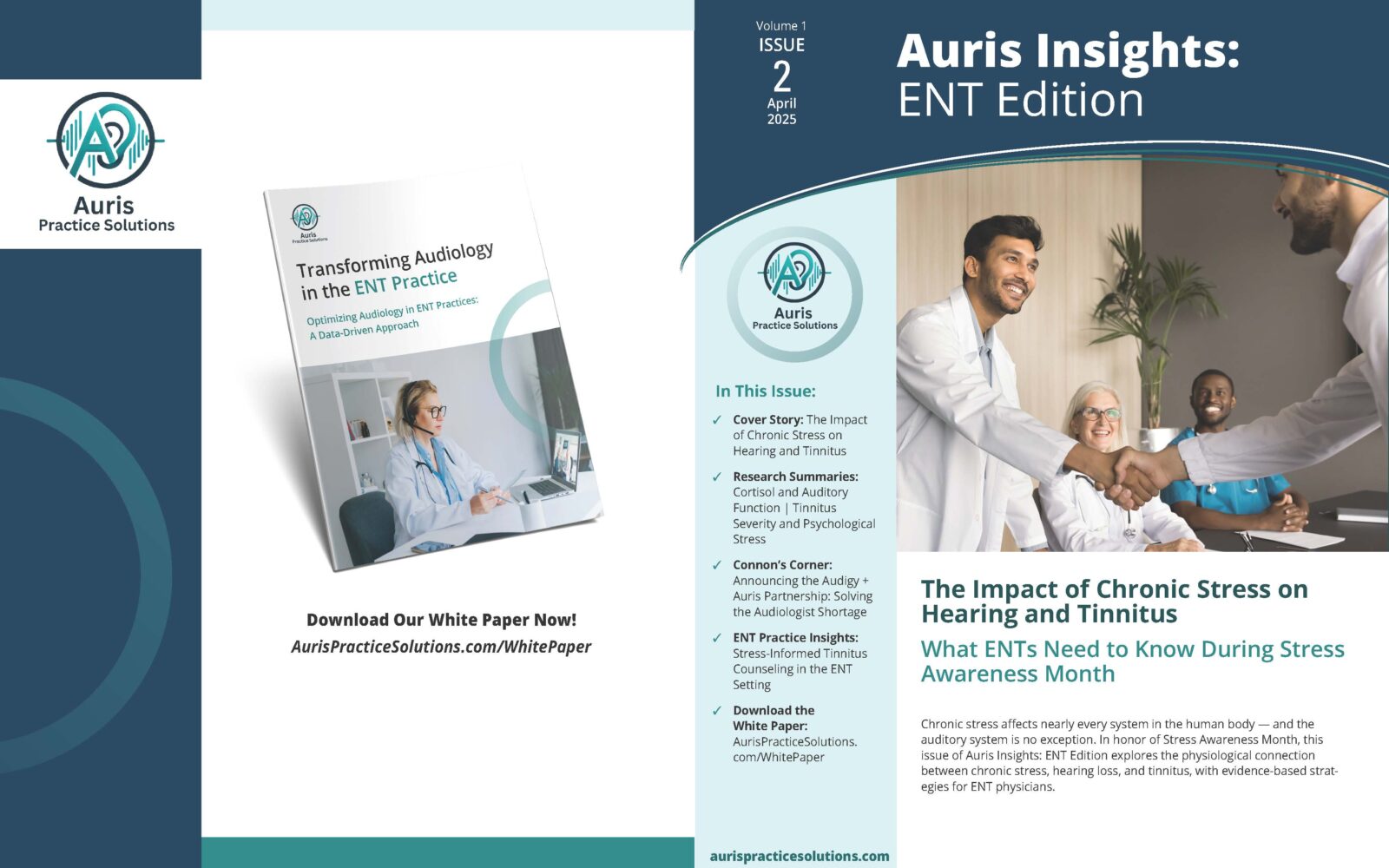
What ENTs Need to Know During Stress Awareness Month

Chronic stress affects nearly every system in the human body — and the auditory system is no exception. In honor of Stress Awareness Month, this issue of Auris Insights: ENT Edition explores the physiological connection between chronic stress, hearing loss, and tinnitus, with evidence-based strategies for ENT physicians.

Understanding the Stress-Auditory Axis

Stress activates the hypothalamic-pituitary-adrenal (HPA) axis, triggering elevated levels of cortisol and adrenaline. Prolonged exposure to these hormones has been shown to impair cochlear blood flow, disrupt auditory neurotransmission, and increase the likelihood of tinnitus onset.

Tinnitus and Emotional Distress

Tinnitus severity often correlates more with perceived distress than with actual audiometric loss. Patients under chronic stress may experience:

  • Worsening of tinnitus symptoms
  • Sleep disturbances
  • Reduced sound tolerance (hyperacusis)
  • Heightened anxiety about their condition

These symptoms can create a vicious cycle that affects both auditory perception and mental health.

Research Summaries: Latest Studies in Audiology

Cortisol and Auditory Function

Canlon et al., 2007 – Journal of Neuroscience

  • Elevated cortisol levels reduced blood flow to the cochlea.
  • Chronic stress led to damage of hair cells in animal models.
  • The stress response affected auditory signal transmission and amplified the perception of tinnitus.

Reference: https://doi.org/10.1523/JNEUROSCI.1197-07.2007

Tinnitus Severity and Psychological Stress

Zöger et al., 2006 – Psychosomatic Medicine

  • Severity of tinnitus correlated more strongly with stress perception than with degree of hearing loss.
  • Anxiety, depression, and sleep disturbances were predictive of tinnitus handicap scores.
  • Stress management interventions improved patient-reported tinnitus burden.

Reference: https://doi.org/10.1097/01.psy.0000238213.84676.a3

Clinical Implications for ENTs

  • Ask about stress levels and life changes in patients presenting with new or worsening tinnitus.
  • Collaborate with audiologists to provide tinnitus counseling with stress-reducing strategies.
  • Refer to behavioral health when needed to support holistic care.

Connon’s Corner: Announcing the Audigy + Auris Partnership

As the ENT and audiology industries grapple with a nationwide audiologist shortage, a new partnership between Audigy and Auris Practice Solutions brings timely, scalable support to practices across the country.

The partnership centers on MaestroAuD™, a remote hybrid audiology model developed by Auris to help practices increase diagnostic capacity and profitability without adding onsite providers. With this alliance, practices gain access to:

  • Remote diagnostic and hearing aid services powered by licensed audiologists
  • Seamless integration with the clinic’s EMR and workflows
  • Onsite support from trained medical assistants or audiology techs
  • 100% revenue-generating time for audiologists — no warranty work or inventory management

“This solution is past due,” says Kim Gilmore, President of Audigy. “ENT and audiology clinics finally have the scalable support they need.”

“Our goal is to help ENT practices grow without being limited by recruitment bottlenecks,” adds J. Connon Samuel, CEO and Co-Founder of Auris.

ENT Practice Insights: Stress-Informed Tinnitus Counseling in the ENT Setting

Stress is both a cause and amplifier of auditory conditions like tinnitus. As physicians on the front line, ENTs are in a powerful position to identify these risk factors early — and intervene with compassionate, evidence-based care.

Through integrated models like MaestroAuD™, ENT practices can not only expand access to audiological care, but better support patients whose auditory symptoms are linked to whole-body health issues like stress.

Download the White Paper Newspaper Here

Book a Discovery Call